Semiconductor
Chamber & Wafer-Handling Parts
Plasma chamber liners and shields, showerhead supports, wafer boat pins, robotic arm end effectors, vacuum chuck insulators, gas distribution rings and ESC core parts in 99.7%–99.8% grades.
99% · 99.5% · 99.7% · 99.8% grades — outstanding electrical insulation, plasma and wear resistance, and the most widely specified ceramic in semiconductor process equipment.
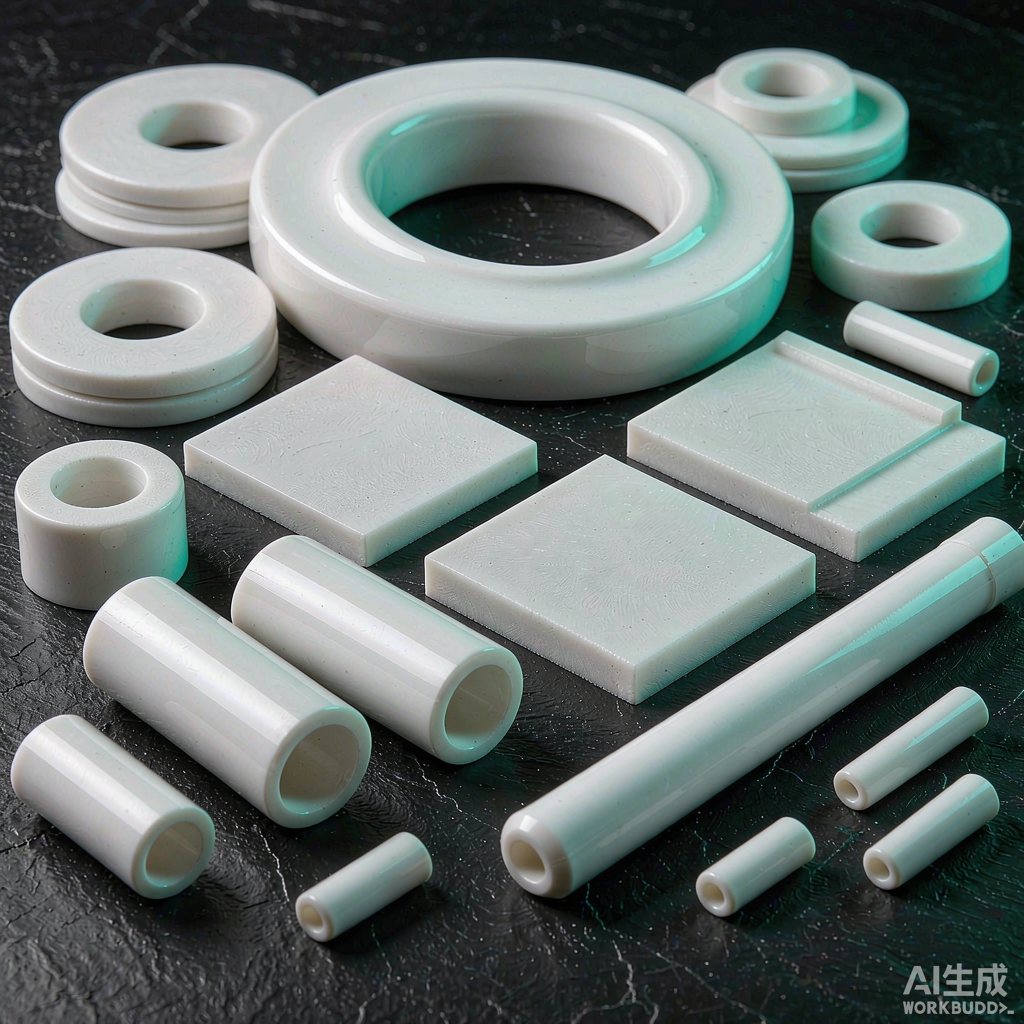
Alumina combines high hardness, excellent dielectric strength and strong resistance to plasma erosion and chemical attack. Our high-purity 99.7% and 99.8% grades minimize particle generation and ionic contamination — the decisive factors for wafer-exposed components.
| Property (typical) | DA-99 | DA-99.5 | DA-99.7 | DA-99.8 |
|---|---|---|---|---|
| Al₂O₃ content (≥ %) | 99.0 | 99.5 | 99.7 | 99.8 |
| Bulk density (g/cm³) | 3.82 | 3.88 | 3.92 | 3.95 |
| Flexural strength (MPa) | 340 | 370 | 400 | 420 |
| Thermal conductivity (W/m·K, 20 °C) | 26 | 27 | 28 | 30 |
| C.T.E. (10⁻⁶/K, 20–1000 °C) | 8.1 | 8.0 | 7.9 | 7.8 |
| Dielectric strength (kV/mm) | 16 | 17 | 18 | 18 |
| Hardness (HRA) | 88 | 88.5 | 89 | 89.5 |
| Max. service temperature (°C, inert) | 1650 | 1700 | 1700 | 1750 |
Typical values for reference; custom specifications and full test reports available on request.
Plasma chamber liners and shields, showerhead supports, wafer boat pins, robotic arm end effectors, vacuum chuck insulators, gas distribution rings and ESC core parts in 99.7%–99.8% grades.
Feedthroughs, standoffs, tube and rod insulators, burner nozzles, heating-element supports and vacuum-interrupter parts where high dielectric strength and temperature stability are required.
Seal rings and discs, pump plungers and sleeves, spray and sandblasting nozzles, thread guides, bearings and precision balls for abrasive or corrosive service.
Diffusion furnace tubes, thermocouple protection tubes, crucibles, kiln rollers and boats for photovoltaic cell manufacturing and high-temperature processes.
Polished alumina carriers, LED package parts, laser-cavity reflectors and sapphire-growth components with high surface finish and purity.
High-purity alumina joint interfaces and instrument components with proven bio-compatibility and a polished, low-friction surface.
Match the grade to how close the part sits to the wafer and how aggressive the environment is. DA-99 (99%) is the economical choice for general insulation, wear parts and furnace furniture. DA-99.5 suits most industrial, LED and photovoltaic hardware. DA-99.7 and DA-99.8 are specified for wafer-exposed semiconductor parts, where sodium, potassium and iron contamination and particle generation have to be minimised.
In a wafer fab, usually yes; in a general industrial application, usually no. The higher price reflects purer powder, tighter sintering control and more inspection. What you get is lower alkali and iron content, higher density (3.95 vs 3.88 g/cm³), higher flexural strength (420 vs 370 MPa) and fewer particles — precisely the factors that drive killer defects on a wafer. If the component never sees a wafer or a plasma chamber, 99% or 99.5% is normally the better commercial decision.
We sinter and machine parts with features from roughly 1 mm up to 600 mm plates. As-fired dimensions are typically held to about ±1%, while diamond-ground features are held to ±0.005 mm with a surface finish of Ra 0.4 µm. Flatness, parallelism and perpendicularity are controlled to your drawing.
Yes. We apply Mo-Mn or tungsten metallization and can braze to Kovar, stainless steel and copper for feedthroughs, vacuum-interrupter parts and ceramic-to-metal assemblies. Metallized alumina is normally supplied in the 99.5%–99.8% grades.
Yes — alumina is one of the two workhorse plasma-facing materials, the other being silicon carbide. Its erosion rate in fluorine and chlorine chemistries is low, and the 99.7%–99.8% grades keep metal contamination inside the particle budget. Where the plasma is very aggressive or the part also sees severe thermal shock, silicon carbide is the better answer.
Tell us your grade, geometry and annual quantity — standard parts ship fast, custom parts start from your drawing.