Mining & Wear Protection
Wear-Resistant Ceramics: The Overview
Alumina tiles and reaction-bonded SiC side by side — the two-material selection table, product forms and the honest cost arithmetic.
Read the overviewA tailings line that eats a steel bend every quarter is not a materials problem — it is a selection problem. This guide explains how slurry wear actually works, which ceramic fits which duty, and how to compare costs without fooling yourself.
For most mining slurry pipelines — moderate velocity, particles under about 5 mm, few impact events — alumina wear tiles (92% or 95% Al₂O₃) are the industry default and the cheapest per tonne conveyed. At high-wear points — pump internals, cyclone apexes, severe elbows, or anything running above roughly 5 m/s with coarse, sharp particles — reaction-bonded silicon carbide (RBSiC) wins on total cost because it is nearly pore-free, far harder, and has no joints or grout lines to fail.
The decision is made by six duty variables, not by hardness alone: particle size distribution, velocity, impact angle, temperature, chemistry, and how the lining is fixed. Get those right and either ceramic outlasts steel by a factor that changes the maintenance schedule, not just the budget.
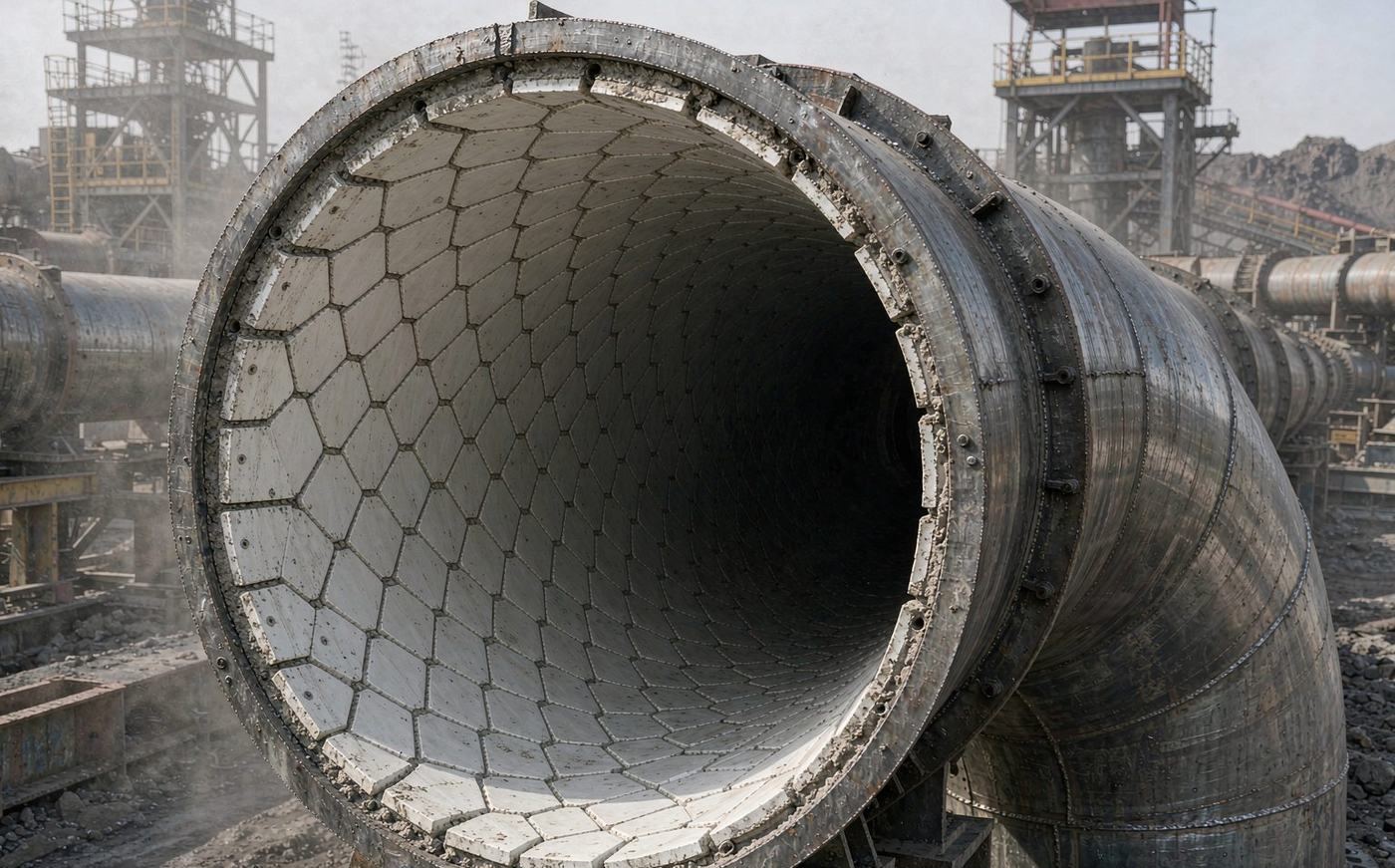
Slurry wear is erosion, not friction. Particles carried in the slurry strike and slide across the pipe wall thousands of times per minute, and each contact removes a microscopic amount of metal. Three things make it brutal in mining service:
Bare steel in a moderately aggressive slurry line is a consumable: 8–14 months for a concentrate or tailings duty is common, and high-wear points are replaced quarterly. The cost is not the steel — it is every shutdown, hot-work permit and crane lift that comes with it.
Almost every wear lining in mining service is one of two materials. They are not competitors so much as complements.
| Property (typical) | DA-92 / DA-95 alumina tiles | DA-SC-R reaction-bonded SiC |
|---|---|---|
| Composition | 92% / 95% Al₂O₃ | SiC ≈ 85–90%, free Si 8–12% |
| Bulk density (g/cm³) | 3.5–3.7 | 3.02–3.10 |
| Hardness (HV) | ≈ 1,000–1,400 | 2,200–2,500 |
| Porosity | Dense sintered body | < 0.1% (silicon-infiltrated) |
| Flexural strength (MPa) | 200–300 | 250–350 |
| Fracture toughness (MPa·m1/2) | 3.5–4.2 | 3.8–4.5 |
| Slurry erosion resistance | Very good | Best of the affordable ceramics |
| Form factor | Tiles: square, rectangular, hexagonal | Cast segments, pipes, cones — near-net shapes |
| Relative cost per kg | Low | ≈ 2–3× alumina |
Alumina tiles are the default because they are cheap, hard and infinitely repairable. Any surface — pipe, chute, hopper, fan casing — can be lined tile by tile, and a worn patch is replaced in minutes without touching the rest of the lining. The system has two weak points, and both are worth knowing before you buy: the tiles are brittle under direct impact, and the fixing layer (adhesive or grout) is usually what fails first in hot or chemically aggressive service.
Reaction-bonded SiC is the specialist for severe points. It is made by infiltrating molten silicon into a SiC skeleton, so the finished body is fully dense — under 0.1% porosity — with no tile joints, no grout and nothing to peel. Where a tiled elbow needs disciplined workmanship to survive, an RBSiC elbow simply is the lining. It costs more per kilogram and it is cast in specific shapes, so it earns its price at the points where failure is expensive: pump wear plates, cyclone cones and apexes, burner and spray nozzles, and the elbows that eat steel quarterly.
Two buyers with the same nominal pipe size can need opposite linings. These are the inputs that matter, in the order our engineers weigh them:
This is the same table our engineers apply to a new duty — read your condition, then confirm with the numbers.
| Duty condition | First choice | Why |
|---|---|---|
| Chutes, hoppers, low-velocity sliding abrasion | DA-92 alumina tiles, adhesive or stud-fixed | Lowest cost per tonne handled; field-repairable |
| Tailings / concentrate line, 3–5 m/s, < 5 mm | Alumina-lined pipe segments (DA-92 / DA-95) | Industry default; replaceable segment by segment |
| Pump discharge, cyclone feed, severe elbows, > 5 m/s | DA-SC-R reaction-bonded SiC | No joints, best erosion resistance, monolithic |
| Cyclone underflow / apex | DA-SC-R cone or apex liner | Highest local velocity and acceleration in the circuit |
| Acidic or reagent-laden slurry (pH < 4) | DA-SC-R, with chemically compatible sealing | Grout and adhesives are the vulnerable part of tiled systems |
| Large-lump impact at transfer points | Ceramic-rubber composite or engineered backing first | Ceramics chip under direct impact; absorb the energy first |
The purchase order is the least informative line in a wear-lining budget. The number that decides the argument is cost per tonne conveyed, and it is easy to compute: lining cost divided by tonnes handled before replacement — plus the cost of every change-out, which on a live concentrator usually dwarfs the part price.
An illustrative comparison for a DN200 concentrate line running about 4 m/s (figures are typical of published site experience — run your own data before committing):
| Option | Relative installed cost | Typical first intervention | What the change-out costs |
|---|---|---|---|
| Bare 12 mm steel | 1× | Holed in roughly 8–14 months | Cut-out and re-weld, hot work, full standby |
| Alumina-tiled spools (DA-92) | ≈ 2–3× | First tile repairs at ~3–5 years | Tile-by-tile patch, no line removal |
| RBSiC spools at severe points | ≈ 3–5× | Inspection-driven; many run far longer | Segment swap at the worst point only |
Notice what the table does not say: that RBSiC is "better". At a quiet straight run it is expensive insurance. At the elbow that dies quarterly, it is the cheapest thing on the site. The engineering judgement is about where, and the honest suppliers are the ones who will tell you where not to spend.
Refurbishment follows the same logic. Tiled equipment is re-tiled patch by patch; RBSiC equipment is surveyed annually and the worst segments are swapped. Either way, the capital asset — the pipe, the chute, the cyclone — stays in service.
Dolphin Advanced Ceramic supplies DA-92 / DA-95 alumina wear tiles, lined pipe segments and DA-SC-R reaction-bonded SiC components from Zibo, Shandong, with pressing, sintering, diamond grinding and assembly in-house. Send four numbers — top particle size, velocity, solids content, temperature — and we will come back with a lining recommendation, a tiling layout or a casting drawing, and a quotation within 24 hours, Monday to Saturday.
Use the RFQ form, email dolphintec@aliyun.com, or send the duty sheet directly on WhatsApp to +86 133 8643 4414. An overview of both materials lives on the wear-resistant ceramics page.
Steel wears by ductile cutting: sharp particles plough grooves in a surface that is soft compared with the mineral. Alumina at roughly 1,000–1,400 HV and reaction-bonded SiC at 2,200–2,500 HV are one to two orders of magnitude harder than the quartz particles doing the damage, so the particles cannot cut them — they can only micro-chip them, which takes far longer.
For most tailings and concentrate lines — moderate velocity, particles under about 5 mm, few impact events — alumina tiles at 92% or 95% are the industry default and the cheapest per tonne conveyed. Where velocity exceeds roughly 5 m/s, particles are coarse and sharp, or the line contains high-wear points such as pump internals and elbows, reaction-bonded SiC usually wins on total cost.
Yes, and that is one of the practical advantages of tiled systems. Worn areas are re-tiled in place, tile by tile or patch by patch, without removing the pipeline from service for more than the repair window itself. Cast reaction-bonded SiC is different: it is supplied as discrete segments, so a worn segment is replaced while its neighbours stay in service.
It slightly reduces the effective diameter and, once polished by the slurry, a ceramic surface is smoother than corroded steel, so friction losses usually stay acceptable. What matters is specifying the lining thickness at the design stage — a DN200 line lined with 20 mm tiles becomes DN160 through the lining — so pumps must be checked against the reduced bore, not the nominal one.
Ask for the duty behind the number. A life figure without the particle size distribution, solids content, velocity and impact description is a marketing number. Reputable suppliers will state the duty their claim came from and will happily calculate cost per tonne conveyed on your data instead — which is the only comparison that survives contact with an operating mine.
Send the duty data and the drawing. Our engineers reply with a lining recommendation and a quotation within 24 hours.