Material Selection
Alumina vs Aluminum Nitride vs Zirconia vs Silicon Carbide
Four ceramic systems cover the overwhelming majority of industrial demand. Here is how they genuinely differ, and the decision rules our engineers.
Read this guideThe purity number on a datasheet describes the alumina content. What determines whether your part works is what the remaining fraction is made of. Here is how to read and write an alumina specification.
The percentage is the Al2O3 content; the small remainder is sintering additives and impurities — typically SiO2, MgO, CaO, Na2O and Fe2O3. Raising purity from 99% to 99.8% increases density (3.82 → 3.95 g/cm³), flexural strength (340 → 420 MPa) and dielectric strength, and it sharply reduces alkali and iron release.
For semiconductor wafer-exposed parts, specify 99.7% or 99.8%. For general insulation, wear and furnace furniture, 99% or 99.5% is usually the better commercial decision.
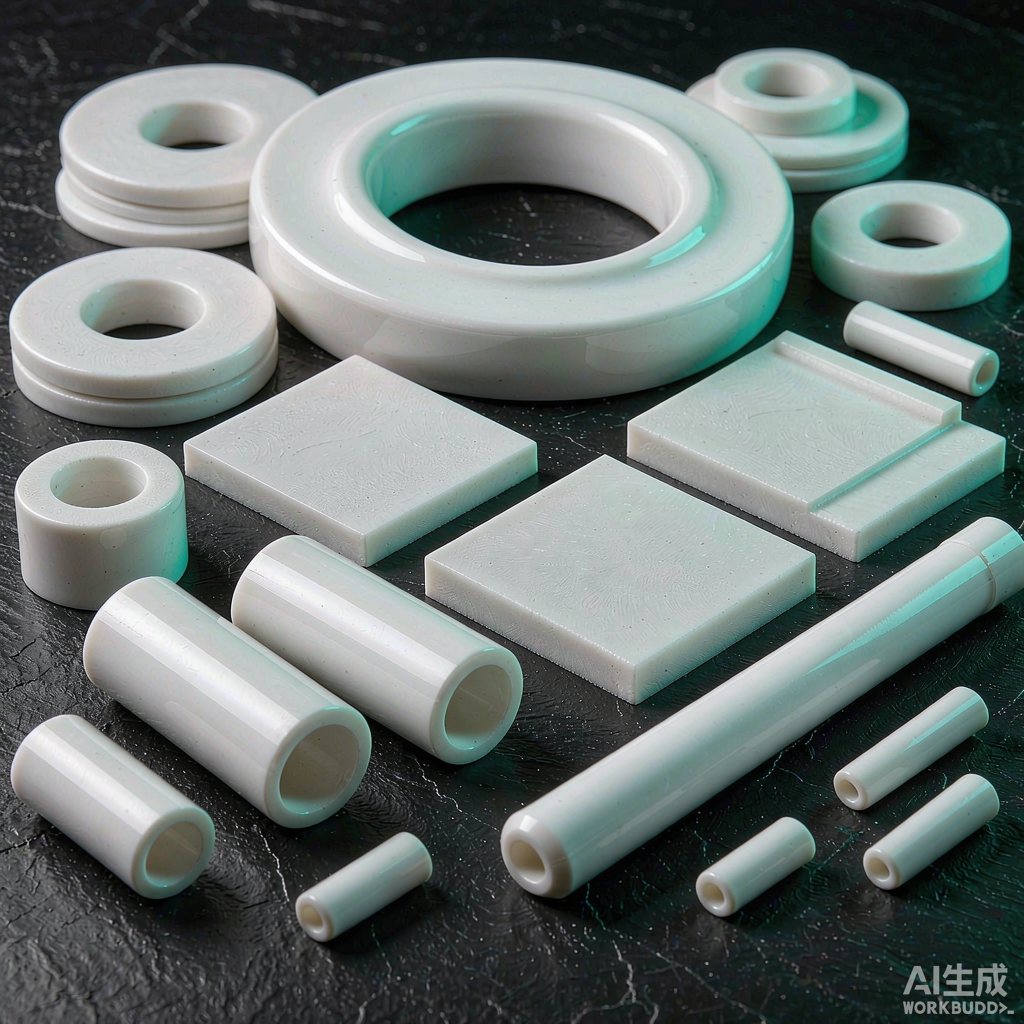
| Property (typical) | DA-99 | DA-99.5 | DA-99.7 | DA-99.8 |
|---|---|---|---|---|
| Al2O3 content (≥ %) | 99.0 | 99.5 | 99.7 | 99.8 |
| Bulk density (g/cm³) | 3.82 | 3.88 | 3.92 | 3.95 |
| Flexural strength (MPa) | 340 | 370 | 400 | 420 |
| Thermal conductivity (W/m·K, 20 °C) | 26 | 27 | 28 | 30 |
| Dielectric strength (kV/mm) | 16 | 17 | 18 | 18 |
| Hardness (HRA) | 88 | 88.5 | 89 | 89.5 |
| Max. service temp. (°C, inert) | 1650 | 1700 | 1700 | 1750 |
Typical values for reference. Custom specifications and full test reports are available on request.
A 99.5% alumina contains 0.5% of something else. That something else is a mixture of two very different things:
This is the key insight: two suppliers can both sell "99.5% alumina" with completely different behaviour, because one has 0.4% MgO and 0.05% Na2O, and the other has 0.3% MgO, 0.15% Na2O and 0.03% Fe2O3. Always specify the impurity limits, not just the alumina content.
Density and porosity. Purer powder sinters to a denser body with fewer closed pores. Density climbs from about 3.82 to 3.95 g/cm³ across the range. Closed porosity is where particles hide and where dielectric breakdown starts.
Grain size and strength. Higher purity allows a finer, more uniform grain structure. Because strength in ceramics scales with the inverse square root of the largest flaw, a finer microstructure means higher flexural strength — 340 MPa at 99% versus 420 MPa at 99.8%.
Dielectric behaviour. Alkali ions are mobile charge carriers. Lowering Na2O and K2O raises volume resistivity and dielectric strength and reduces dielectric loss — relevant for feedthroughs, RF insulators and high-voltage parts.
Particle generation. Purer, denser, finer-grained alumina sheds fewer particles under plasma attack and mechanical contact. In a fab, particle counts are measured per wafer, and a component can be rejected on particle performance alone.
Metal contamination. When plasma erodes a ceramic, the atoms it releases enter the process environment. Iron and copper from impurities become electrical traps in silicon. This is the single strongest argument for 99.7%–99.8% in wafer-exposed positions.
Moving up a grade is not a matter of ticking a box on an order form. Higher purity means:
The result is that 99.8% alumina commonly costs 30–80% more than 99% for the same geometry. Whether that premium is worth it depends entirely on where the part sits.
Worth it:
Not worth it:
Our experience: roughly 70% of alumina enquiries are over-specified. Reviewing the specification against the actual environment is the fastest cost reduction available in a ceramic programme.
A specification that lets two suppliers quote the same part, and lets you compare them, looks like this:
Two of these lines do most of the work: the impurity limits and the surface finish. Everything else is comparatively easy to hit.
We measure the chemistry of the finished part, not only the incoming powder, because contamination can be introduced at milling and sintering. Typical checks are:
Results go on the certificate of analysis supplied with the shipment. If a customer needs a specific test method or an external laboratory, we will say so in the quotation rather than assume it.
Tell us where the part sits, what it faces and what failure looks like. That is usually enough for us to recommend a grade — and to tell you honestly when the cheaper one will do. The RFQ checklist covers what to include.
No. Higher purity brings higher density, strength and dielectric performance and lower contamination, but it also costs significantly more. If the part does not sit near a wafer and does not face aggressive plasma or high voltage, 99% or 99.5% will usually perform identically in service at a lower cost.
The hardness difference across our alumina grades is small — about 88 to 89.5 HRA — because hardness is largely a property of the alumina crystal itself. The real gains from purity show up in density, strength, dielectric behaviour, particle generation and contamination, not in hardness.
You should, and we encourage it. Alkali and iron limits (Na2O, K2O, Fe2O3) describe what actually matters for electrical and contamination performance. Two 99.5% aluminas from different sources can behave very differently if their impurity profiles differ. Specify both the Al2O3 content and the impurity ceilings.
Sapphire is single-crystal Al2O3 with no grain boundaries or sintering additives, giving superior optical and dielectric performance. Polycrystalline high-purity alumina is far cheaper, can be produced in complex shapes, and is the right choice for the great majority of structural, insulating and chamber components. Choose sapphire only when optical transparency or single-crystal properties are required.
Send us the drawing, the grade and the quantity. Our engineers reply with a manufacturability review and a quotation within 24 hours.