Mining & Wear Protection
Hydrocyclone Wear Parts
A hydrocyclone concentrates the whole pump's energy into a small vessel — which is why it wears out faster than anything else in the circuit. Where.
Read this guideA coal dense-medium cyclone wears differently from an ore hydrocyclone: a magnetite medium, coarse raw coal and enormous tonnage through a large vessel. A part-by-part wear map, what polyurethane, alumina and RBSiC each survive, and an honest cost-per-year comparison.
A coal dense-medium cyclone (DMC) is one of the highest-tonnage wear vessels in any preparation plant — a single 1,000–1,400 mm DMC can pass 250–450 t/h of raw coal suspended in a dense magnetite medium. The wear concentrates in four places: the inlet, the first turn of the cylinder, the lower cone, and the apex. Everything else is comparatively quiet.
The honest material split is: polyurethane and rubber liners are often good enough in medium-sized DMCs on clean coal feeds; alumina tile liners (DA-92/DA-95) are the workhorse where tonnage and reject content are high; reaction-bonded SiC (DA-SC-R) earns its price at the apex and lower cone, where wear rates are extreme and a change-out stops the plant. The magnetite medium itself is a fine, hard abrasive that punishes every surface at all times — even when the coal is soft.
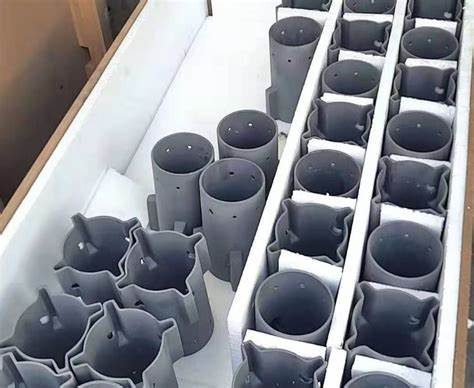
If you have read our guide on ore hydrocyclone wear parts, note that a coal dense-medium cyclone is a different animal, and the difference comes from the medium. An ore cyclone runs water and solids; a DMC runs raw coal suspended in finely ground magnetite and water at a controlled density — typically 1.3–1.8 SG. That changes the wear problem in three ways:
The consequence for lining selection: DMC wear is a combination of fine-particle sliding abrasion (medium), sliding abrasion with coarse sharp particles (reject in the underflow), and localized impingement at the inlet. No single material is best at all three, which is why the best installations mix materials by zone.
Wear in a DMC is not uniform, and the parts do not fail in a random order. Across plants the pattern is consistent enough to rank:
| Zone | Dominant wear mechanism | Relative wear rate | What it costs when it fails |
|---|---|---|---|
| Apex / spigot | Coarse reject sliding and jamming at high concentration, smallest cross-section | 1.0 (fastest) | Underflow density drifts; the cut degrades before the part is visibly "worn out" |
| Lower cone | Accelerated sliding as the flow area shrinks toward the apex | 0.6–0.8 | Wall thinning leads through to apex failure; often changed with the apex |
| Inlet / feed volute | Direct slurry impingement at full feed velocity | 0.5–0.7 | Feed short-circuits the swirl; cut quality and EPM fall noticeably |
| Cylinder, first turn | High-speed helical flow of medium + coarse coal against the wall | 0.4–0.6 | Gradual; usually caught at scheduled inspection |
| Cylinder / cone, remainder | Medium abrasion, moderate velocity | 0.2–0.4 | Long-term; sets the liner system's overall life |
| Vortex finder (overflow) | Medium-laden flow, less solids; erosion-corrosion if steel | 0.1–0.3 | Overflow solids rise; magnetite losses in the overflow increase |
Two things in this table deserve emphasis. First, the apex fails fastest and matters most: the apex diameter is a process set-point, so a worn apex quietly changes the cut — clean coal ash creeps up and yield creeps down for days or weeks before anyone changes the part. Second, the vortex finder looks unimportant until it wears; then magnetite losses in the overflow show up as media consumption, which in a large plant is a bigger annual number than the cyclone liners themselves.
| Material | Life vs plain steel shell (typical DMC duty) | Impact tolerance | Max lining thickness in practice | Main weakness | Best role in a DMC |
|---|---|---|---|---|---|
| AR / Ni-hard steel | 1× (baseline) | Excellent | Thick sections possible | Fastest wear per mm; magnetite eats hardened steel steadily | Shell structure; bolted repair patches |
| Rubber | 2–4× | Best | 20–50 mm | Cuts on sharp reject; medium finds any unbonded edge | Inlet areas with tramp-metal risk; small DMCs |
| Polyurethane | 3–6× (fine medium duty) | Good | 15–40 mm | Sharp coarse reject at velocity cuts it; ~80 °C limit | Medium-sized DMCs on lower-reject feeds; vortex finders |
| Alumina tiles (DA-92/DA-95) | 8–20× | Low — chips under heavy direct impact | 10–25 mm tiles on formed shells | Impact; joint lines; needs flat backing | Cylinder and cone linings, inlet protection, large DMCs |
| RBSiC (DA-SC-R) | 15–30×+ (apex, lower cone) | Moderate in thick monolithic parts | Thick one-piece sections 20–50 mm | Cost; brittle like all ceramics | Apex liners, lower cone inserts, one-piece wear segments |
Honest notes on this table. The multiples are field-typical for sliding abrasion and fall toward the low end where reject is coarse and sharp. Polyurethane is genuinely competitive in many coal DMCs — it is lighter, faster to change and forgiving of impact — and we lose nothing by saying so: its limits are sharp coarse reject, and its cutting failure is sudden rather than gradual. Ceramics, by contrast, wear slowly and predictably, which is worth money in a plant that plans shutdowns.
| DMC zone | First choice | Alternative | Why |
|---|---|---|---|
| Apex / spigot (replaceable) | Solid RBSiC (DA-SC-R) segment or collar | Ni-hard, changed frequently | Smallest passage, highest concentration; a ceramic apex here runs for months instead of weeks |
| Lower cone | RBSiC insert or alumina tiles, thick | PU liner (short change-outs acceptable) | Accelerating wear toward the apex; ceramic buys the plant shutdown interval |
| Inlet / feed head | Alumina tiles (DA-92/DA-95), well staggered | Rubber where tramp metal is common | Impingement zone; tiles handle the velocity, rubber handles the accident |
| Cylinder, first turn | Alumina tiles | RBSiC segments on severe duty | Fast helical flow; hardness decides |
| Cylinder / cone body | Alumina tiles 10–20 mm | PU on smaller cyclones | Medium abrasion dominates; tiles give predictable long life |
| Vortex finder | PU or alumina-lined tube | Stainless if erosion-corrosion dominates | Lower wear, but a failure raises media losses |
Note the pattern — it repeats throughout coal preparation: ceramic where flow is fast and steady, elastomer where things can hit or jam. The apex is the exception that proves it: the reject there is coarse and concentrated, but the passage is so small and the wear so fast that a thick ceramic part is still the economic answer, provided it is made as a replaceable segment rather than a permanent lining.
A deliberately simple worked example. A 1,150 mm DMC on a high-reject feed, running 6,000 h/year. Steel-shell cyclone with Ni-hard apex: apex changes every 6 weeks, cone liner every 9 months — call it 8 apex change-outs a year at 6 h of downtime and parts cost each time. A ceramic route: DA-SC-R apex at roughly 4–6× the Ni-hard price, changed 1–2 times a year; DA-95 tile-lined cone lasting beyond 24 months.
To quote DMC wear parts honestly, we need:
With that, we will quote zone by zone and tell you where ceramic pays and where it does not.
Dolphin Advanced Ceramic manufactures DA-92 and DA-95 alumina wear tiles and formed liners, and DA-SC-R reaction-bonded silicon carbide apex liners, cone inserts and cyclone segments, from Zibo, Shandong — pressing, sintering to 1800 °C and diamond grinding in-house, with certificates of analysis on every lot. Send the worn part's drawing or photo to dolphintec@aliyun.com or WhatsApp +86 133 8643 4414, or use the RFQ form. The wear-ceramics line overview is on the wear-resistant ceramics page; related guides: ore hydrocyclone wear parts, slurry pump wet-end parts and slurry pipeline linings.
The apex is the smallest cross-section in the vessel and carries the highest concentration of the material that actually causes wear — the coarse reject. Coal itself is soft; the stone, pyrite and sand rejected to the underflow slide and jam through a narrow passage, so wear rates at the apex are commonly several times the cone average. This is also why the apex should be designed as a cheap, quick-change segment rather than a permanent lining: match thick ceramics to slow wear, and replaceable parts to fast wear.
It depends on reject load and cyclone size, and polyurethane is often the right answer. In medium-sized DMCs on lower-reject feeds, PU liners give good life, weigh little and change out fast. The limits are sharp coarse reject at velocity (PU cuts suddenly rather than wearing gradually) and temperature above about 80 °C. As reject percentage and tonnage rise, alumina tiles (DA-92/DA-95) on the cylinder and cone, and an RBSiC apex, take over — mainly because their wear is slow and predictable enough to plan around.
The medium causes a large share of it. Magnetite is a hard mineral ground to below 100 µm and present at every surface at all times, at densities of 1.3–1.8 SG. It produces uniform fine-particle sliding abrasion across the whole vessel, including zones the coal barely touches. That is why a DMC lined only against coarse coal wear fails on the quiet zones first — and why even the vortex finder needs a wear material eventually.
Joint layout. In a DMC the flow follows a helical path down the wall, and a straight joint line running in the flow direction is a pre-drawn wear line — magnetite particles find the slightly recessed joint and undercut the tiles. The fix is staggering joints like brickwork, keeping joints tight, and tapering or capping any exposed tile edge facing upstream. Where joint erosion keeps recurring in a small area, that is the zone for a one-piece ceramic segment instead of tiles.
Compare cost per year, not price per part, and include three items: parts, planned downtime and cut quality. In a worked example on a large DMC, an RBSiC apex at 4–6× the Ni-hard price changed once or twice a year instead of eight times typically wins on parts alone, and decisively once avoided unplanned stoppages and stable separation set-points are counted. The honest counter-case: on small cyclones with low reject and fast PU change-outs, the ceramic premium may never repay — and we will tell you when that is the case.
Send us the drawing, the grade and the quantity. Our engineers reply with a manufacturability review and a quotation within 24 hours.