Mining & Wear Protection
Hydrocyclone Wear Parts
A hydrocyclone concentrates the whole pump's energy into a small vessel — which is why it wears out faster than anything else in the circuit. Where.
Read this guideCeramic in a slurry pump pays on the three parts that set internal clearance — not across the whole wet end. A part-by-part guide to erosion rate, material choice, and where high-chrome or rubber is still the right answer.
Do not ceramic-line a whole slurry pump. Ceramic pays on the two or three parts that set the pump's internal clearances and flow paths — above all the throat bush, then the suction-side wear plate, then the impeller where the pump is small enough. The volute is usually a lining or insert job rather than a solid-ceramic casting, and the casing itself is the structure: keep it steel.
Two honest exceptions. In coarse, high-head duty — crusher discharge with 50 mm+ lumps — rubber-lined or high-chrome pumps still win, because ceramic cannot absorb that impact and thick rubber can. And in pumps that are deliberately run as sacrificial items, the ceramic version often costs more per tonne than simply changing a high-chrome throat bush more often.
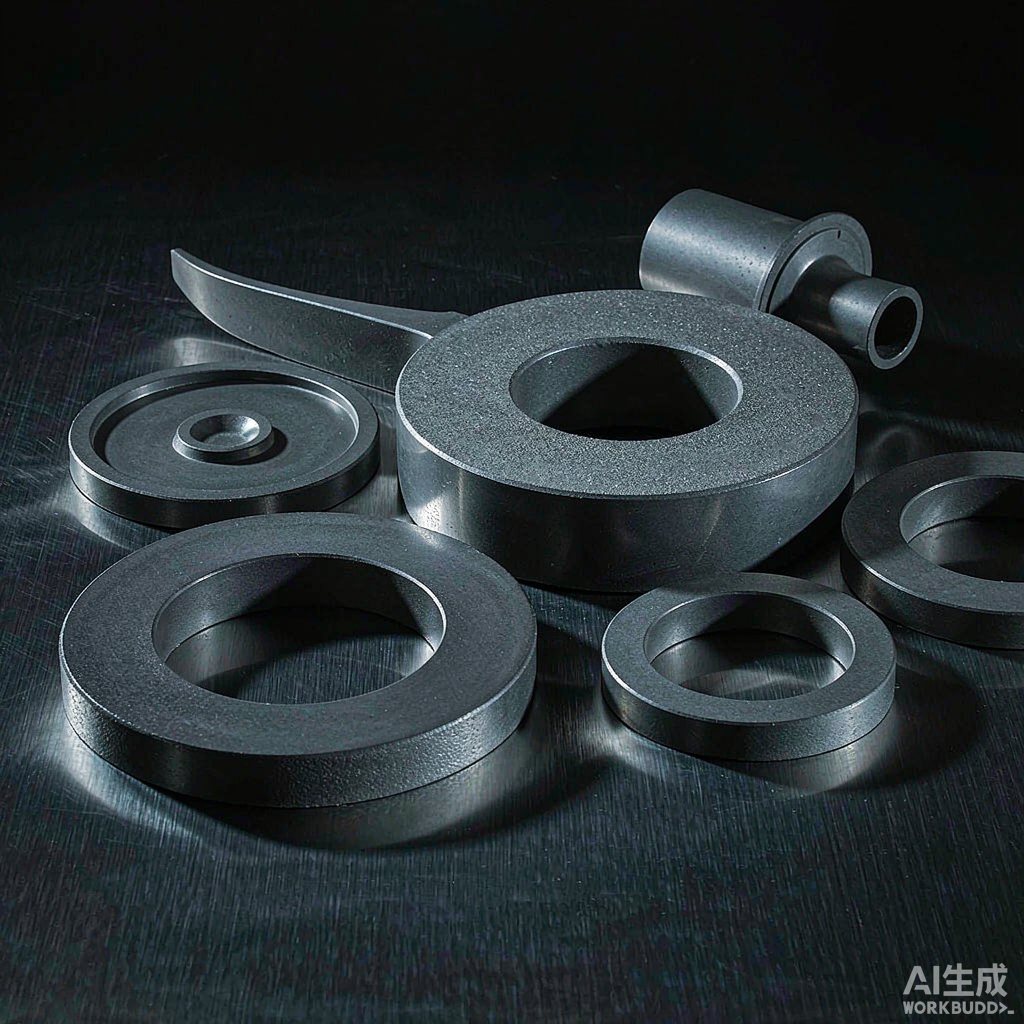
A centrifugal slurry pump fails from the inside out, and the wear is not evenly distributed. In a typical mill-circuit pump the order of destruction is remarkably consistent:
| Part | What kills it | Relative wear rate | Why it goes first |
|---|---|---|---|
| Throat bush (liner front) | High-velocity recirculation through the clearance gap | 1.0 (fastest) | Flow is squeezed through a 1–3 mm gap at full head, straight at the bush bore |
| Suction-side wear plate | Angled particle impact plus recirculation eddies | 0.6–0.8 | Sees both the incoming stream and the returning leakage flow |
| Impeller — vane leading edge and shroud | Impact at the inlet eye, sliding abrasion along the passage | 0.5–0.7 | Particles accelerate from axial to radial; shroud clearance flow adds more |
| Volute liner / casing liner | Sliding abrasion at the cutwater, impact where the stream leaves the impeller | 0.3–0.5 | Lower velocity than the impeller, but a large area |
| Discharge-side wear plate | Abrasion plus occasional coarse-particle trapping | 0.3–0.4 | Protected by the impeller shroud most of the time |
| Shaft sleeve / expeller | Fine solids in the sealing flow, corrosion | 0.1–0.2 | Small area, but a leak here stops the pump just as effectively |
The throat bush being first is not an accident of design — it is where the pump converts a small clearance into a large velocity. Which is also why it is the single best place to spend money on ceramic.
The classic empirical form for slurry erosion is that material loss per unit time rises with the 2.5th to 3rd power of impact velocity:
Wear rate ∝ v2.5–3.0
That exponent is the most useful number in pump wear work, because it explains things operators find counter-intuitive:
Practical consequence: before choosing a material, ask what the pump is doing. A pump running at 1,200 rpm with a 300 mm impeller has a tip speed near 19 m/s; the same pump at 1,500 rpm is at 23.5 m/s, and wear rises by roughly 60% for a 25% speed increase. No material change fixes that arithmetic better than slowing down or going to a bigger, slower pump.
| Route | What it is | Wall thickness | Size range | Relative cost | Best for |
|---|---|---|---|---|---|
| Solid reaction-bonded SiC part | Throat bush, wear plate or small impeller made entirely of DA-SC-R | As designed, 8–25 mm | Small to medium pumps, typically ≤ 200 mm discharge | High per part, lowest per hour in fine slurry | Throat bushes, wear plates, small impellers in abrasive fine slurry |
| Ceramic tile lining | Alumina or RBSiC tiles bonded or stud-welded into a steel volute or casing half | 10–25 mm tiles | Any size, no upper limit | Medium | Large volute liners and pipe spools where a solid ceramic casting is impractical |
| Ceramic insert / segmented ring | Ceramic ring or segments in a metal carrier, replaced as a unit | 10–20 mm | Medium | Medium | Field-replaceable throat bushes and wear plates without re-machining the pump |
| Thin coating (thermal spray, CVD) | 100 µm–1 mm layer on a metal substrate | 0.1–1 mm | Any | Low | Corrosion-dominant or fine-particle duty; not for coarse abrasion |
The honest ranking: a thin coating dies quickly under real abrasion because there is no thickness reserve — once it wears through at a hotspot, the substrate is exposed and the coating around it undercuts. Coatings are a corrosion answer with a modest abrasion bonus, not a replacement for thick ceramics in mill duty.
| Part | High-chrome (27% Cr) baseline | Ceramic option | Honest verdict |
|---|---|---|---|
| Throat bush | 3–10 weeks in mill duty | Solid RBSiC (DA-SC-R) or alumina insert | Best ceramic application in the pump. 4–8× life typical in fine abrasive slurry; pays back through clearance and efficiency as well as life |
| Suction wear plate | 2–4 months | Solid RBSiC plate or tile-lined plate | Strong second. Large flat area, sliding/angled impact, no direct coarse impact — well suited to ceramic |
| Impeller | 3–6 months | Solid ceramic impeller (small pumps); ceramic vane inserts | Conditional. Only worth it below about 200 mm discharge. Above that, cost, balance and handling risk dominate — use high-chrome or polyurethane-coated |
| Volute liner | 4–8 months | Alumina or RBSiC tile lining on a steel shell | Works, but is a lining job. Needs a flat, sound backing and careful joint staggering; the cutwater is the weak point |
| Casing / structural shell | Years | None — keep steel | Do not ceramic. Ceramic cannot carry bolt loads, thread, or the pump's structural duty |
| Shaft sleeve / gland | 6–12 months | Alumina or SiC sleeve; better: expeller + flush | Solve the sealing first. A ceramic sleeve on a leaking gland just wears out more expensively |
Note the pattern: ceramic wins on flat, replaceable, clearance-setting parts in fine slurry, and loses on large, impact-loaded, structurally loaded parts. That single sentence answers most pump enquiries correctly.
Operators usually justify ceramic on wear life. The bigger number is often efficiency.
A centrifugal slurry pump recirculates slurry through the gap between impeller and throat bush. As that gap grows, recirculation grows with it: head falls, flow falls, and the pump quietly consumes more power per tonne pumped. A throat bush that starts at 1 mm and is condemned at 5 mm can cost several percentage points of efficiency long before it is changed — and in a large mill circuit that is continuous money, not a maintenance line item.
To quote pump wear parts properly we need:
With those four we will tell you which parts are worth ceramic and which are not — including telling you when the answer is "keep your high-chrome pump".
Dolphin Advanced Ceramic manufactures DA-SC-R reaction-bonded silicon carbide throat bushes, wear plates, impellers and tile linings, and DA-92/DA-95 alumina tiles for volute and pipe lining, from Zibo, Shandong — pressing, sintering to 1800 °C and diamond grinding in-house, with a certificate of analysis on every lot. Send the pump drawing and the duty to dolphintec@aliyun.com or WhatsApp +86 133 8643 4414, or use the RFQ form. The line overview is on the wear-resistant ceramics page; related guides: hydrocyclone wear parts, slurry pipeline linings and grinding media and mill linings.
Usually you can retrofit the replaceable wear parts — throat bush, wear plates and suction liner — as ceramic versions made to the same envelope, keeping the casing, shaft and bearing assembly. What you generally cannot do is turn the casing or volute into a solid ceramic part, because those carry the pump's structural and bolt loads. For volutes, the practical route is a tile lining bonded or stud-welded into the existing steel shell, which also requires a flat, sound backing surface.
Cracking almost always means impact rather than abrasion: coarse particles at high velocity, tramp metal, cavitation collapse, or a bush installed with a point load on its face (a burr or an uneven seat). RBSiC is hard but brittle — it has no plastic zone to absorb a point load. Check three things: the maximum particle size in the feed, the suction conditions for cavitation, and the flatness and cleanliness of the seat before installation.
For fine abrasive slurry on the clearance-setting parts — throat bush, suction wear plate — yes, typically 4–8× the life of 27% Cr white iron, plus a slower and more predictable wear trend. For coarse lump feed, high head, or pumps exposed to tramp metal, high-chrome or rubber-lined pumps are the better engineering choice, and often the cheaper one per tonne pumped. The mistake is treating the choice as a brand preference rather than a function of particle size and velocity.
It varies with pump and duty, but a throat bush that has opened from 1 mm to 5 mm can cost several percentage points of pump efficiency through internal recirculation, on top of the reduced head and flow. In a mill circuit running 8,000 hours a year that is a continuous power cost, not a one-off maintenance cost. This is why we argue for measuring the clearance monthly and changing on trend rather than waiting for the pump to stop performing.
As a working rule, above roughly 10–15 mm maximum particle size, impact energy starts to dominate and rubber's elasticity beats ceramic's hardness. Below that, in the fine and medium slurry typical of mill circuits, ceramic's abrasion resistance wins comfortably. The full decision also needs velocity and head, which is why we ask for the impeller diameter and speed in every pump enquiry.
Send us the drawing, the grade and the quantity. Our engineers reply with a manufacturability review and a quotation within 24 hours.