Material Science
99%, 99.5%, 99.7% or 99.8% Alumina
The purity number on a datasheet describes the alumina content. What determines whether your part works is what the remaining fraction is made of..
Read this guideFour ceramic systems cover the overwhelming majority of industrial demand. Here is how they genuinely differ, and the decision rules our engineers apply when a customer sends a drawing.
Alumina (Al2O3) is the default choice: low cost, excellent electrical insulation, good plasma and wear resistance. Aluminum nitride (AlN) is for parts that must remove heat while remaining electrically insulating. Zirconia (ZrO2) is for parts that take impact, bending or need a sharp chip-free edge. Silicon carbide (SiC) is for plasma-facing, thermal-shock and very-high-temperature duty.
If the part sits inside a semiconductor process chamber, the selection is driven less by these general rules and more by contamination budget: what metal does the material release when the plasma eats it?
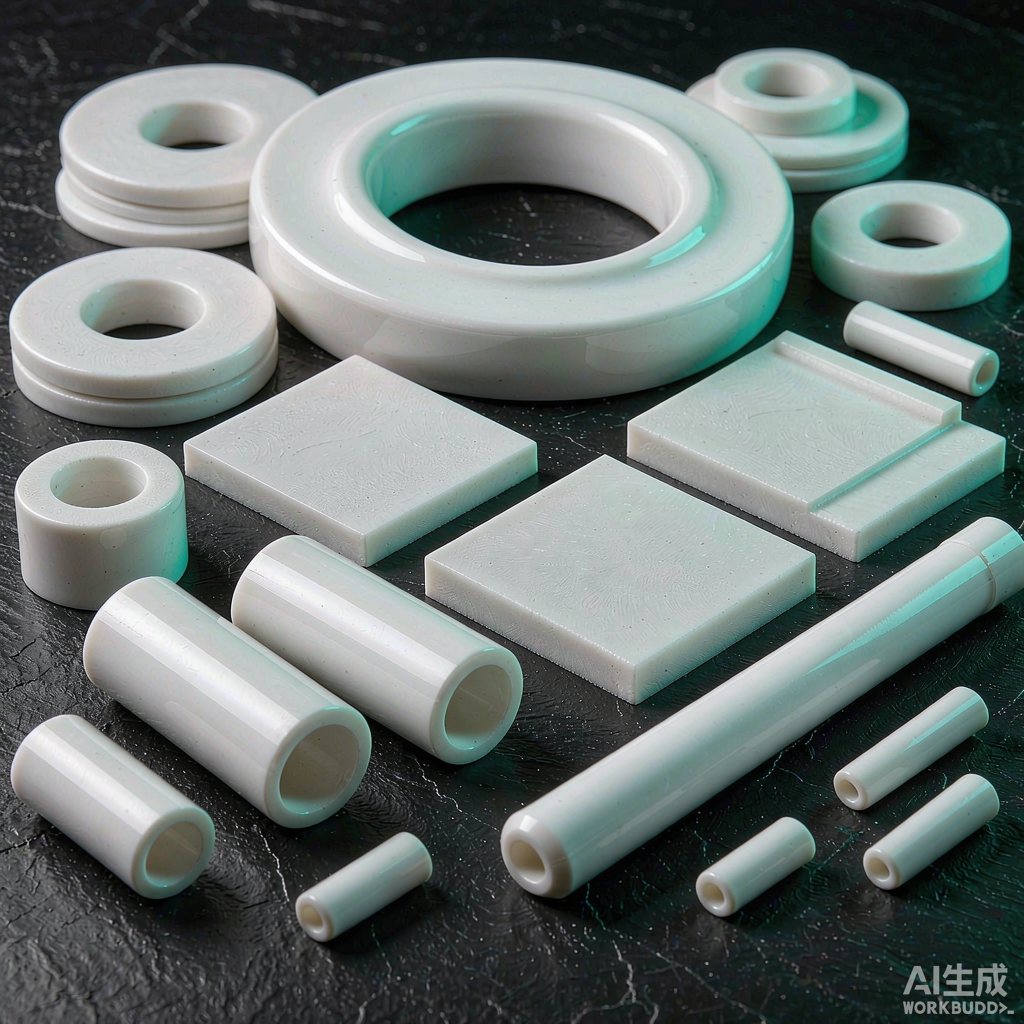
All figures below are typical values for the grades we manufacture; they are confirmed per order in the certificate of analysis.
| Property | Alumina 99.8% | AlN | Zirconia Y-TZP | SiC (SSiC) |
|---|---|---|---|---|
| Thermal conductivity (W/m·K) | 30 | ≥170–200 | 2–3 | 110–120 |
| Flexural strength (MPa) | 420 | 350–380 | 900–1200 | 380–420 |
| Fracture toughness (MPa·m½) | 3–4 | 3–4 | 8–10 | 3.5–4.5 |
| Hardness (HV) | ~1500 | ~1200 | 1250–1350 | 2600–2800 |
| Max. service temp. (°C) | 1750 (inert) | ~1000 (air) | ~1000 | ~1600 (inert) |
| Electrical insulation | Excellent | Excellent | Good | Good (semi-conductive at high T) |
| Plasma resistance | Good | Moderate | Moderate | Excellent |
| Relative part cost | Low | High | Medium | High |
Alumina is the most widely specified technical ceramic in the world, and for good reason. It combines high hardness, excellent dielectric strength (16–18 kV/mm), strong resistance to chemical and plasma attack, and a raw-material cost that no other engineering ceramic can match.
We manufacture four purity grades — 99%, 99.5%, 99.7% and 99.8% — and the choice between them matters far more than most buyers expect. See our dedicated guide on what alumina purity actually changes.
Specify alumina when:
AlN is unusual: it is an electrical insulator with the thermal conductivity of some metals. At ≥170–200 W/m·K it dissipates heat roughly six times better than alumina while staying a dielectric — the combination that makes it indispensable in power electronics.
Its coefficient of thermal expansion (4.5 ×10⁻⁶/K) is also closer to silicon than alumina's is, which lowers the interfacial stress on bonded dies and improves thermal-cycling life.
Specify AlN when:
The trade-off is price — roughly two to three times alumina on a like-for-like part — and a lower maximum service temperature in air. Below roughly 800 °C it is excellent; above that, oxidation becomes the design constraint and silicon carbide or alumina is the better answer.
Y-TZP zirconia is the strongest and toughest of the four. Flexural strength of 900–1200 MPa and fracture toughness of 8–10 MPa·m½ put it in a different class: it deforms locally and absorbs energy instead of chipping.
That property changes what you can design. A ceramic cutting blade in alumina will micro-chip along the edge; in zirconia it stays keen. A plunger in alumina will spall under point loading; in zirconia it survives.
Specify zirconia when:
Two caveats. First, zirconia has poor thermal conductivity (2–3 W/m·K), so it is the wrong material wherever heat must move. Second, it is susceptible to low-temperature degradation in warm, humid service — talk to us about the environment before specifying it for long-duration aqueous duty.
High-purity sintered SiC is the most chemically and thermally robust of the four. Hardness of 2600–2800 HV makes it one of the hardest materials you can machine into a part, thermal conductivity of 110–120 W/m·K lets it shed heat, and its low expansion (4.2 ×10⁻⁶/K) gives outstanding thermal-shock resistance.
In semiconductor etch equipment these properties made SiC the material that replaced alumina in the most aggressive positions — particularly focus rings and chamber hardware.
Specify SiC when:
The cost is real: SiC is expensive to sinter and expensive to diamond-grind because of its hardness. Be sure the application needs it — SiC specified for a part that only sees moderate wear is money that never comes back.
When a customer sends a drawing without specifying a grade, we work through this sequence:
Most parts in a semiconductor tool are answered by question 4, which is why alumina remains the highest-volume material in our plant by a wide margin.
Buyers are often surprised that the material is not the main cost driver. In practice the split for a custom part looks roughly like this:
The practical consequence: relaxing a tolerance from ±0.005 mm to ±0.05 mm, or removing a purely cosmetic surface requirement, can cut the price of an alumina part by a third without affecting function. Tell us which dimensions are genuinely critical and which are "nice to have".
Specifying on hardness alone. Hardness tells you about abrasion resistance, not about whether the part will survive a knock. Zirconia is softer than alumina on paper but far more likely to survive a service life.
Using alumina where the plasma is aggressive. Alumina works in many etch processes, but in a high-power fluorine chemistry its erosion rate is several times that of SiC, and the aluminium it releases ends up on the wafer. Model cost of ownership over the part's life, not just the purchase order.
Ignoring the remaining percentage. "99.8% alumina" describes the Al2O3 content, not the impurity budget. What matters is what the other 0.2% is made of. Our purity guide explains how to write the specification properly.
If you send a drawing, add the application and the environment — temperature, medium, plasma chemistry, electrical duty and expected life. That context often changes our recommendation, and it costs you nothing. Our RFQ checklist lists the ten points that let us quote accurately the first time.
Alumina. It offers the best balance of electrical insulation, wear resistance, chemical stability and raw-material cost, and it has over a century of industrial manufacturing experience behind it. In our plant it is by far the highest-volume material across semiconductor, photovoltaic, LED and general industrial applications.
Only where heat flow is the design constraint. AlN conducts roughly six times as much heat as alumina while still insulating, and its expansion is closer to silicon. If your part does not need to move heat, alumina will almost always be the better commercial choice.
Y-TZP zirconia is normally limited to about 1000 °C, lower than alumina or SiC. Zirconia-toughened alumina (ZTA) can go to roughly 1400 °C while keeping some of the toughness benefit. If sustained high temperature is combined with impact loading, talk to us about the specific duty cycle.
Because of the process, not only the powder. SiC must be sintered at very high temperature with tight control, and because it is 2600–2800 HV it can only be shaped by diamond grinding, which is slow and wears tooling quickly. For plasma-facing and high-temperature parts the longer service life usually more than repays the price.
Send us the drawing, the grade and the quantity. Our engineers reply with a manufacturability review and a quotation within 24 hours.