Mining & Wear Protection
Ceramic Linings for Mining Slurry Pipelines
Why steel fails in slurry service, alumina 92/95% tiles vs reaction-bonded SiC, the six duty variables that decide the choice — and an honest.
Read this guideIn chemical and power-plant slurry duty the ceramic is rarely the weak link — the fixing system is. Where erosion and corrosion arrive together, which ceramic survives which chemistry, and the hot-caustic trap that most suppliers never mention.
In chemical and power-plant slurry duty the ceramic rarely fails first — the fixing system does. Tiles outlive their adhesive, grout lines corrode open, and the steel behind them erodes. The practical rules: RBSiC or sintered SiC for acidic, chloride-bearing and high-velocity duty; alumina tiles for near-neutral sliding abrasion; monolithic parts wherever chemistry would attack a joint. One warning most suppliers skip: never run free-silicon reaction-bonded SiC in hot concentrated caustic — specify sintered SiC, which contains no free silicon, instead.
Treat the ceramic, the fixing method and the housing as one system, and chemical wear protection stops being a lottery.
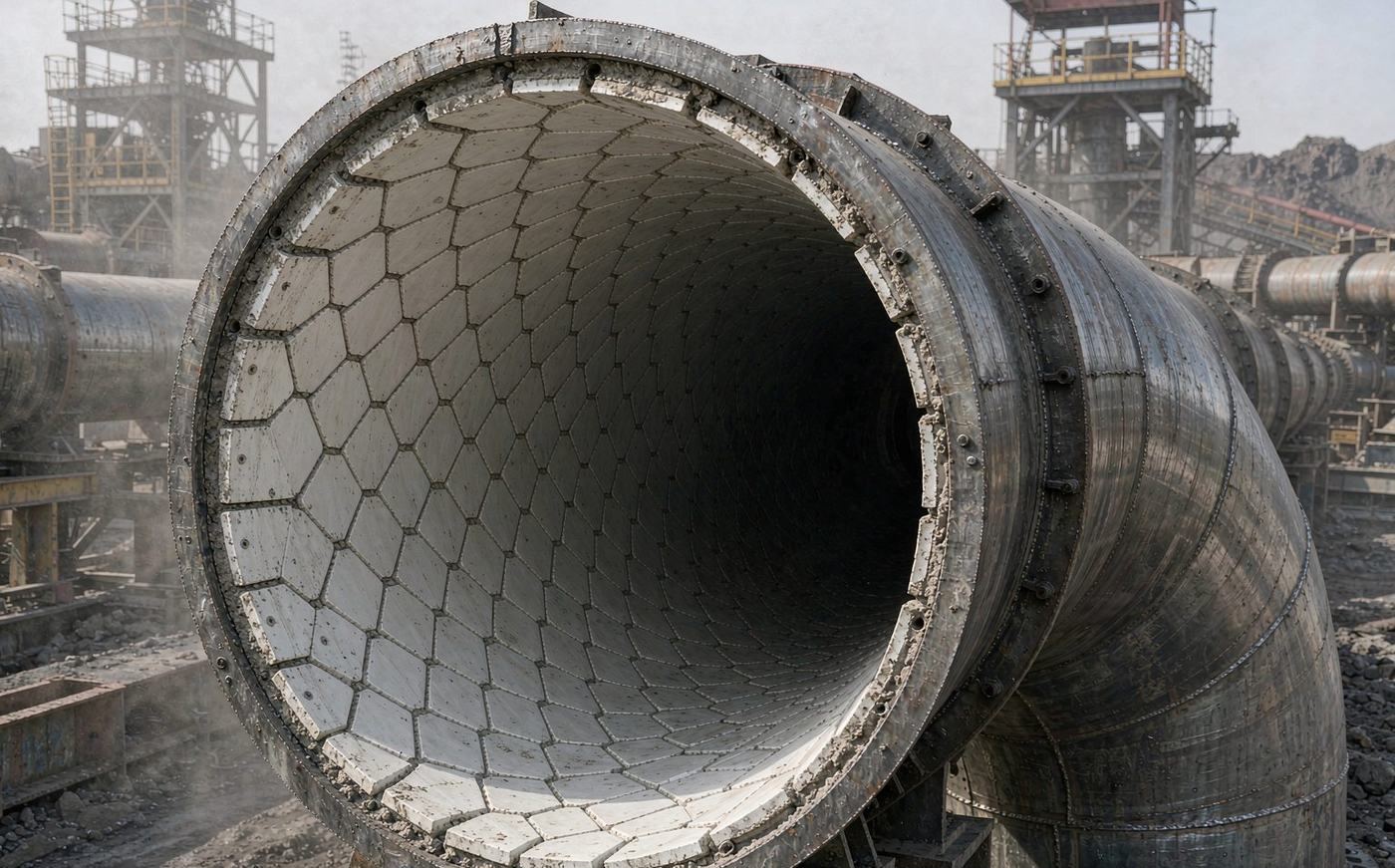
In a mine, abrasion is the enemy and chemistry is usually a footnote. In a chemical plant the two arrive together, and that changes the engineering completely. Erosion strips the protective film from a metal surface and corrosion re-forms it — pits start where particles hit, so wear and corrosion multiply rather than add. And every part of the installation is exposed, not just the ceramic face:
So the selection question in chemical duty is never "which ceramic?" — it is "which ceramic and which fixing system, at this temperature, in this chemistry?" The sections below cover the four duties where we see the most enquiries.
Flue-gas desulfurization is the largest chemical wear-ceramics market by installed area, and it is a well-defined duty: limestone slurry at 15–30 wt% solids, sharp-edged gypsum crystals, pH 4.5–6, chlorides concentrated by evaporation to anything from 5,000 to 30,000 ppm, at 45–60 °C. Every element of that list attacks something.
What fails first in a tiled FGD lining is almost never the tile. It is the joint — grout attacked by acid condensate, or adhesive softened at a hot spot, after which the undercut tile lifts and the flow does the rest. Which is why the fixation table below matters as much as the material table.
Wet-process phosphoric production may be the most aggressive abrasion-corrosion combination in industry: 28–54% P₂O₅ at 70–90 °C, with fluoride and chloride species present, carrying gypsum and silica solids through pumps, agitators and transfer lines. Metals either corrode or are unaffordable; rubber protects tanks but cannot survive the pump wet-end.
This is the classic case for silicon carbide. RBSiC and sintered SiC pump parts — impellers, casing liners, shaft sleeves, bearings — resist both the acid and the solids. The economics usually close quickly: a SiC wet-end part costing several times the rubber equivalent that lasts five to ten times as long in a service where change-outs dominate the maintenance calendar.
Alumina refineries (Bayer process), chemical digestion and some pulp applications run hot concentrated sodium hydroxide — 20–30 wt% NaOH at 140–250 °C. Three ceramics that are heroes elsewhere quietly die here:
The material that survives is sintered SiC (SSiC): no free silicon, fully densified by solid-state sintering, and by a wide margin the most alkali-tolerant of the common technical ceramics. If a supplier offers you RBSiC for hot caustic service, that is a disqualifying answer. Ask the free-silicon question explicitly — it takes one sentence and it has saved entire lining installations.
| Material | Acids | Chlorides | Hot alkali | Abrasion | Typical chemical-duty role |
|---|---|---|---|---|---|
| DA-92 / DA-95 alumina | Good in dilute acids; avoid HF | Excellent | Poor — dissolves | Very good | Low-cost linings for near-neutral slurry, gypsum handling, brine |
| DA-SC-R reaction-bonded SiC | Excellent (except HF) | Excellent | Not suitable — free Si attacked | Best | FGD and phosphoric pump wet-ends, cyclones, severe elbows |
| Sintered SiC (SSiC) | Excellent | Excellent | Best of the SiC family | Excellent | Hot caustic, high-purity and ultra-severe duties |
And the fixation systems, which decide whether any of the above reaches its potential:
| Fixing method | Temperature limit | Chemical limits | Where it wins |
|---|---|---|---|
| Epoxy adhesive bonding | ~120–150 °C | Good broadly; check chlorides, solvents, hot alkali | Cheap, smooth, large areas in moderate duty |
| Vinyl-ester / furan cements | ~120–180 °C | Tuned to the medium — acid-rated or alkali-rated, not both | Tiled linings where chemistry rules out epoxy |
| Stud-welded / mechanically anchored tiles | Limited by tile, ~500 °C+ | No adhesive in the medium | Hot spots, aggressive chemistry, field-replaceable areas |
| Monolithic cast parts (RBSiC / SSiC) | Ceramic limit | Nothing to attack | Pump internals, cyclones, nozzles, severe elbows |
| Duty | First choice | Why |
|---|---|---|
| FGD recirculation pump wet-end | DA-SC-R RBSiC | Highest velocity with gypsum solids and chlorides |
| Gypsum dewatering cyclone | Monolithic RBSiC cone + apex | No grout lines in acid duty |
| Limestone slurry pipe, 2–4 m/s | Alumina tiles, chloride-rated epoxy | Lowest cost per tonne; joints acceptable at low velocity |
| Wet-process phosphoric pump | RBSiC or SSiC | Acid plus fluoride plus solids — metals lose |
| Hot caustic digestion / Bayer | Sintered SiC only | No free silicon; alumina and RBSiC are disqualified |
| Chlor-alkali brine transfer | Alumina or RBSiC | Chlorides harmless to both; abrasion usually modest |
| TiO₂ chloride-process slurries | RBSiC / SSiC | Combined chlorine chemistry and hard TiO₂ solids |
Chemical quotations live or die on the full chemistry. Send:
With those five, we will state the ceramic, the fixation system and its limits explicitly — and tell you if rubber-lined steel is the honest answer.
Dolphin Advanced Ceramic manufactures DA-SC-R reaction-bonded silicon carbide and sintered SiC components, DA-92 / DA-95 alumina wear tiles and lined assemblies from Zibo, Shandong — pressing, sintering to 1800 °C and diamond grinding in-house, with certificates of analysis on every lot. Send the chemistry, the temperature and a photo of the failed part to dolphintec@aliyun.com or WhatsApp +86 133 8643 4414, or use the RFQ form. An overview of the wear-ceramics line lives on the wear-resistant ceramics page, and the mining-side selection logic in the slurry lining guide.
The ceramic face is selected precisely because it resists the medium; the joint material is chosen for cost, workability and temperature, and it is thinner, softer and chemically less resistant than the tile. Acid condensate, chloride migration and thermal cycling attack the joint lines first. Once one grout line opens, the flow undercuts the neighbouring tiles and the lining fails from the joints inward. In chemically aggressive duty, monolithic parts or mechanically fixed tiles avoid the problem entirely.
No. RBSiC contains 8–12% free silicon left over from the infiltration process, and hot concentrated sodium hydroxide attacks silicon chemically, destroying the network that holds the body together. For hot caustic duty — Bayer process liquors, chemical digestion — specify sintered SiC, which contains no free silicon. Always ask a supplier for the free-silicon content of any SiC part destined for alkali service.
Both are used, split by velocity and consequence. Alumina tiles bonded with a chloride-rated epoxy are the economical choice for low-velocity piping, chutes and gypsum handling. Silicon carbide — usually reaction-bonded — takes the high-velocity points: recirculation pump wet-ends, dewatering cyclones and severe elbows, where its higher hardness and monolithic construction outlast both rubber and tile systems by several multiples.
In the wet-end parts — impellers, casing liners, throat bushes — silicon carbide routinely outlasts rubber by a wide multiple in acidic, chloride-bearing or finely abrasive duty, and it does not swell or age. Rubber remains better where large impact energy or tramp metal is present, and for very large, low-speed tanks. The honest test is the failure mode of the rubber part: if it is cutting and erosion, ceramic wins; if it is tearing from impact, rubber stays.
Standard epoxy systems are good for roughly 120–150 °C continuous; specialty cements extend this, and mechanically anchored or stud-welded tiles remove the adhesive limit altogether, taking you to the tile's own temperature capability. If the duty includes thermal cycling as well as temperature, mechanical fixing also avoids the differential-expansion stress that opens bonded joints over time.
Send us the drawing, the grade and the quantity. Our engineers reply with a manufacturability review and a quotation within 24 hours.