Mining & Wear Protection
Ceramic Linings for Mining Slurry Pipelines
Why steel fails in slurry service, alumina 92/95% tiles vs reaction-bonded SiC, the six duty variables that decide the choice — and an honest.
Read this guideA hydrocyclone concentrates the whole pump's energy into a small vessel — which is why it wears out faster than anything else in the circuit. Where the wear lands, why the apex is the expensive failure, and how to choose between polyurethane, alumina and reaction-bonded SiC.
Three parts of a hydrocyclone do nearly all the wearing: the apex (spigot), the cone wall and the inlet head. For fine feed at moderate pressure, polyurethane is the sensible default. For coarse, sharp or high-solids feed — and for the apex of almost any high-pressure cyclone — reaction-bonded silicon carbide (DA-SC-R) lasts three to five times longer than polyurethane and beats cast alumina because it can be cast as a one-piece, near-zero-porosity liner with no joints to open.
The hidden cost is not the part. A worn apex degrades the separation before anyone changes it: underflow density falls, coarse particles report to overflow, and the rest of the circuit pays. Cyclone wear parts are a classification-efficiency decision, not just a consumables line item.
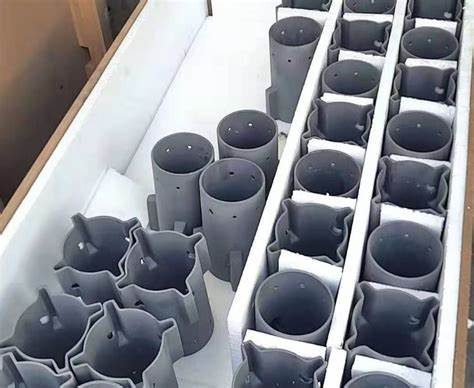
A hydrocyclone has no moving parts, yet it wears faster than the pumps feeding it. The reason is energy density: the entire pump head — commonly 50–200 kPa of feed pressure, driving slurry through the inlet at 5–10 m/s — is spent inside a vessel the size of a barrel. Every joule of that energy is delivered by particles scraping, sliding and colliding with the internal surface.
Wear does not distribute evenly. It concentrates in four zones, each with its own mechanism:
Because the mechanisms differ by zone, the right answer is often a hybrid: one material for the cone, another for the apex. That is not indecision — it is how the best-run plants do it.
Most wear parts announce themselves. The apex does the opposite — it wears larger, which makes the cyclone run better-flowing and worse-classifying at the same time. The apex diameter sets the underflow rate and density; as it erodes open:
Nobody shuts a plant because an apex looks worn. The loss arrives quietly in the assay. This is why the operating rule is to measure the apex inner diameter on a schedule — monthly is typical, weekly on severe duty — with a simple gauge, and log the wear rate in millimetres per thousand hours. Replace on trend, not on failure. A logged wear rate also converts directly into a spares forecast, which is worth more than any supplier's life promise.
Every material on this list is used in real plants. None is "best" — each wins a specific band of duty.
| Material | Hardness | Relative apex life* | Continuous temp limit | Best at |
|---|---|---|---|---|
| White iron / Ni-Hard steel | 550–750 HV | 1× (reference) | ~500 °C | Large, rigid housings; lowest capital |
| Natural rubber | Elastic | 1–3× | ~80 °C | Coarse, impact-rich feed; absorbs tramp hits |
| Polyurethane | Elastic | 2–4× | ~70–80 °C | Fine to medium feed; the sensible default at low pressure |
| Alumina tiles / cast (DA-92 / DA-95) | 1,000–1,400 HV | 3–6× | Limited by fixing, ~150–200 °C bonded | Cones and inlet heads in mid-duty; cheap hard option |
| Reaction-bonded SiC (DA-SC-R) | 2,200–2,500 HV | 5–10× | Effectively none for this duty | Severe apexes and cones; coarse, sharp, high-velocity feed |
| Tungsten carbide (WC-Co) | 1,400–1,800 HV | 5–10× | ~600 °C | Very small, very severe parts — at several times the cost per kg |
*Typical multiples for coarse, sharp silica feed at high pressure. At fine-particle, low-pressure duty the spread collapses — polyurethane can outlast alumina there, because the wear mechanism shifts and elasticity starts to matter more than hardness.
Two material facts drive the table. First, hardness wins at the apex: the particles are coarse, the angles are steep, and an elastic surface that would shed shallow-angle sliding gets cut instead. Second, joint integrity matters as much as hardness: a tiled alumina cone is only as good as its adhesive and grout lines, while a cast RBSiC cone is a monolithic body with nothing to peel — under 0.1% porosity, no seams, no grout.
| Duty | First choice | Why |
|---|---|---|
| Desliming, feed < 0.5 mm, < 70 °C, moderate pressure | Polyurethane | Elastic enough, cheap to hold as spares, easy to swap |
| Classification, 0.5–3 mm feed, standard pressure | PU cone with RBSiC apex, or alumina head + PU cone | Spends the premium only where wear actually concentrates |
| Coarse or recursive feed, > 3 mm, or high pressure | RBSiC apex + cone (DA-SC-R) | Hardness plus monolithic body; the only option that holds ID on trend |
| Feed above 80 °C | Ceramics only (alumina or RBSiC) | Polyurethane and rubber age rapidly above their limits |
| Acidic or reagent-laden feed | RBSiC monolithic | No grout or adhesive to be attacked; dense body resists chemistry |
| Heavy tramp-impact risk | Rubber first, ceramic behind it | Ceramics chip; absorb the impact before the ceramic sees it |
The hybrid in row two deserves emphasis. A polyurethane cone with a cast RBSiC apex is the configuration we ship most often for classification duty: the cone sees shallow-angle sliding where PU is comfortable, and the apex sees the convergence where only a hard monolithic body survives. The premium material goes exactly where the wear is, and nowhere else.
Take a battery of six 500 mm classification cyclones on coarse ore. The apex is the recurring change-out. An illustrative comparison — run your own numbers before committing:
| Apex option | Relative part cost | Typical life multiple | Change-outs per year | Hidden cost |
|---|---|---|---|---|
| Polyurethane | 1× | 1× | 4–6 | ID drifts between changes; underflow density falls late in life |
| Cast alumina | 1.5–2.5× | 2–3× | 2–3 | Tile joints limit reliability at the apex radius |
| RBSiC (DA-SC-R) | 2.5–4× | 4–6× | ≤ 1 | Lowest — and ID holds, so the cut point holds |
On a 100 t/h circuit, one percent of coarse material misplacing to overflow is one tonne per hour of material doing the wrong thing downstream. Even a fraction of that dwarfs the difference in liner price — which is why plants that track classification efficiency rarely argue about apex material for long.
Dolphin Advanced Ceramic supplies DA-SC-R reaction-bonded silicon carbide cyclone cones, apex liners and feed-chamber parts, DA-92 / DA-95 alumina tiles and lined components from Zibo, Shandong, with casting, sintering and diamond grinding in-house. Send five numbers — cyclone model or diameter, feed size distribution, solids content, feed pressure, and maximum temperature — and we will come back with a liner recommendation and a quotation within 24 hours, Monday to Saturday.
Use the RFQ form, email dolphintec@aliyun.com, or send the duty sheet directly on WhatsApp to +86 133 8643 4414. The broader lining choice is covered in the slurry pipeline lining guide.
The apex sees the coarsest particles at the highest local velocity and the highest solids concentration, converging into an orifice that is a fraction of the cyclone diameter. The cone wall sees a decelerating spiral sliding at a shallow angle — a much gentler mechanism. That is why a hybrid build (elastic cone, ceramic apex) is often the best-value configuration.
Measure the inner diameter on a schedule — monthly is typical, weekly on severe duty — and log the wear rate in millimetres per thousand hours. Replace on trend, not on failure. Rising underflow flow rate, falling underflow density and a shift from roping to spraying discharge are the operating symptoms of an apex that has already worn too far.
At the apex and in severe coarse duty, yes: RBSiC is harder (2,200–2,500 HV versus 1,000–1,400 HV), nearly pore-free, and cast as a monolithic body with no tile joints or grout to fail. In mid-duty cones at moderate pressure, cast alumina or even polyurethane can be the more economical choice. Match the material to the zone, not to the catalogue.
Yes — it is one of the most common configurations in classification service. The cone sees shallow-angle sliding where polyurethane performs well, and the apex gets the hard monolithic material it needs. Confirm that the ceramic apex interchanges with your existing housing and clamp arrangement before ordering.
Cyclone model or diameter with the housing drawing, feed particle size distribution, solids content, feed pressure, maximum and normal temperature, and slurry chemistry (pH and reagents). With those, a manufacturer can recommend material per zone, confirm interchangeability and quote within a day.
Send us the drawing, the grade and the quantity. Our engineers reply with a manufacturability review and a quotation within 24 hours.