Material Selection
Alumina vs Aluminum Nitride vs Zirconia vs Silicon Carbide
Four ceramic systems cover the overwhelming majority of industrial demand. Here is how they genuinely differ, and the decision rules our engineers.
Read this guideIn high-power etch processes, alumina erodes several times faster than silicon carbide and releases aluminium into the process. Here is what that means for cost of ownership, and how to decide.
Plasma erodes ceramic surfaces through a combination of ion bombardment and chemical attack. In fluorine and chlorine chemistries, high-purity sintered SiC erodes several times more slowly than alumina, conducts heat about four times better (110–120 vs 26–30 W/m·K) and does not release aluminium into the process.
For focus rings, chamber liners, showerhead hardware and high-temperature carriers, that combination usually wins on total cost of ownership even though the part costs more. For mild plasmas and insulating positions, alumina remains the sensible choice.
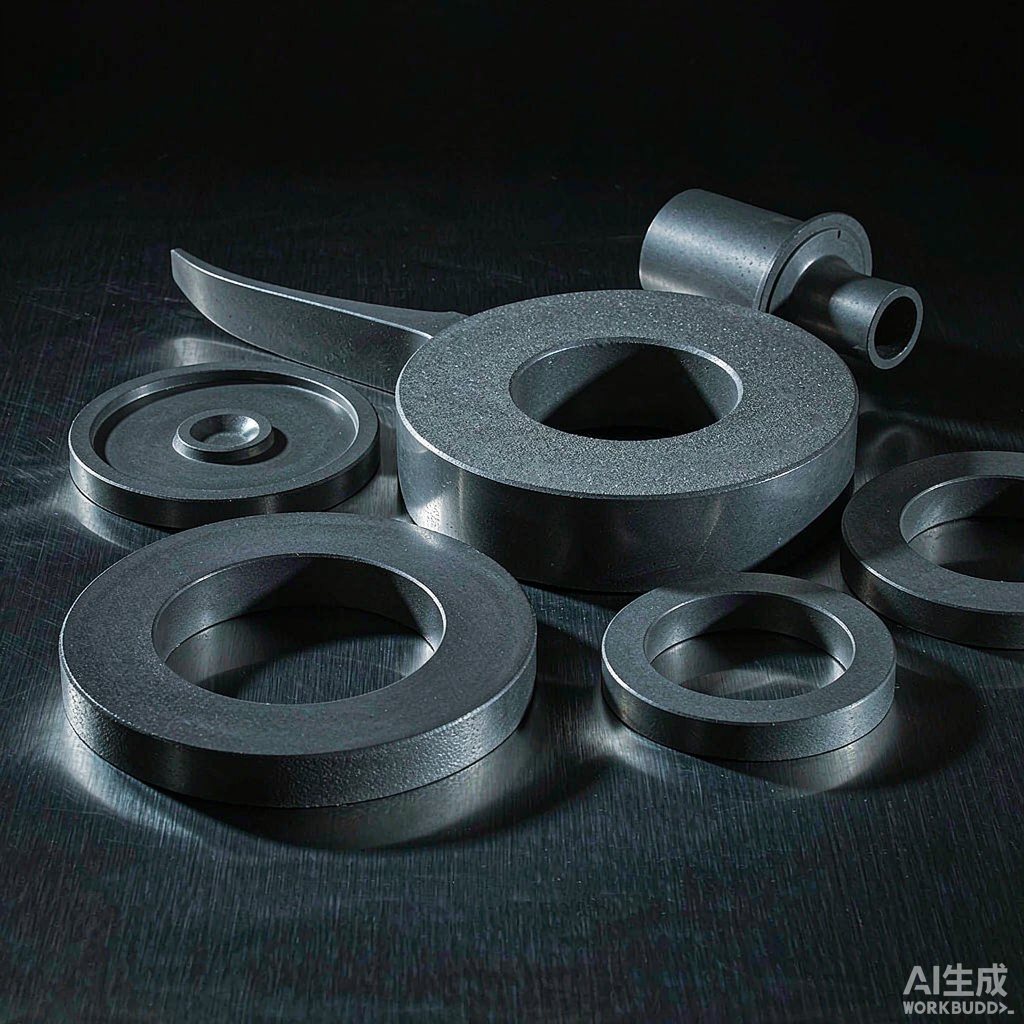
A process plasma is not a hot gas. It is a partially ionised environment containing energetic ions, reactive radicals and electrons, and each of those damages a surface in a different way.
The practical consequence is that chamber materials are consumed, and the question is never whether a part erodes — it is how fast, and what it leaves behind.
Silicon carbide is a covalently bonded carbide ceramic with hardness of 2600–2800 HV — roughly twice that of alumina — and high bond energy. It resists physical sputtering better than most oxides simply because it takes more energy to displace its atoms.
Chemically, the fluorine and chlorine species that attack alumina form relatively involatile aluminium compounds, which stay on the surface and can act as a mask or as a source of particles. Silicon, by contrast, forms volatile SiF4 in fluorine chemistries, which leaves the surface cleanly rather than accumulating.
SiC also brings three secondary advantages that matter as much as erosion rate:
The focus ring sits around the wafer on the electrostatic chuck and shapes the plasma sheath at the wafer edge. It is, in most etch tools, the fastest-wearing ceramic component — and it wears precisely where uniformity matters most.
As the ring erodes, its height and edge profile change. That changes the local plasma density, which changes the etch rate at the wafer edge. The result is the failure mode every process engineer knows: the ring is not "broken", it simply stops producing a uniform wafer, and it has to be replaced on a uniformity schedule rather than on a mechanical one.
Two consequences follow:
This is why focus rings have progressively moved from alumina to high-purity SiC, and why some processes use yttria (Y2O3) coatings over a lower-cost substrate. Each route is a different trade between part price, life and contamination.
| Option | Erosion resistance | Contamination risk | Relative cost | Best for |
|---|---|---|---|---|
| Alumina 99.5% | Baseline | Medium (Al release) | Low | Mild plasma, insulating positions |
| Alumina 99.8% | Moderately better | Lower (fewer metal ions) | Low–medium | Wafer-exposed but not extreme positions |
| High-purity SiC (SSiC) | Much better | Low | High | Focus rings, liners, high-power etch |
| RBSiC | Better than alumina | Low–medium (free Si) | Medium | Large parts where cost and size dominate |
| Y2O3-coated parts | Very good while coating holds | Low, until coating fails | Medium–high | Specific chemistries, short-cycle replacement |
| Quartz | Poor in F chemistry | Low metallic, high particle | Low | Non-critical, non-etch positions |
None of these is universally right. RBSiC contains 8–12% free silicon, which improves manufacturability and cost for large parts but makes the material less uniform in erosion; coated parts perform superbly until the coating is breached, at which point behaviour changes abruptly.
A worked example makes the trade-off concrete. Suppose an alumina focus ring costs 100 units and lasts 400 RF-hours, while a high-purity SiC ring costs 320 units and lasts 1,600 RF-hours in the same process.
SiC is roughly 20% cheaper per hour of process time even though each part costs more than three times as much. Now add the factors the simple sum misses:
Run the numbers with your own replacement interval and tool cost per hour before deciding. In our experience the answer flips to SiC far more often than the part price suggests — but not always, and it is worth doing the arithmetic rather than assuming.
SiC is not a default. Keep alumina where:
Three things separate a good SiC supplier from a source of parts that merely look right:
We produce high-purity sintered SiC (DA-SC, no free silicon) and reaction-bonded SiC (DA-SC-R) and diamond-grind to ±0.005 mm in-house. See the SiC material page for the full property table, or send a drawing.
SiC erodes more slowly under ion bombardment and in fluorine and chlorine chemistries, conducts heat about four times better, withstands thermal shock and does not release aluminium into the process. That combination gives longer replacement intervals and lower defectivity for wafer-exposed, plasma-facing parts.
No. Alumina is still the right choice where the part must insulate electrically, where the plasma is mild, where geometry is complex and cost-sensitive, or where the part is not wafer-exposed so erosion has no contamination consequence. SiC wins where life and cleanliness both matter in a high-power process.
SSiC (sintered silicon carbide) contains no free silicon and offers the best erosion resistance and strength — 380–420 MPa — at higher cost. RBSiC (reaction-bonded) contains 8–12% free silicon, which makes large and complex parts easier and cheaper to produce but reduces erosion uniformity and strength (250–350 MPa).
Usually by process outcome, not by visual inspection. As the ring erodes, its height and edge profile change, which alters the plasma sheath at the wafer edge and degrades etch uniformity. Most fabs replace on a uniformity-drift schedule; the erosion rate therefore sets the cost of ownership more than part price does.
Send us the drawing, the grade and the quantity. Our engineers reply with a manufacturability review and a quotation within 24 hours.